
Review & get 10% off
Review this product and we’ll give you 10% off your next purchase. Write a review →
We offer 10% off your next purchase for every honest review, positive or negative.
Thank you for your review!
Here is 10% off your next purchase:
One use per customer. Cannot be combined with other offers.
We offer 10% off your next purchase for every honest review, positive or negative.
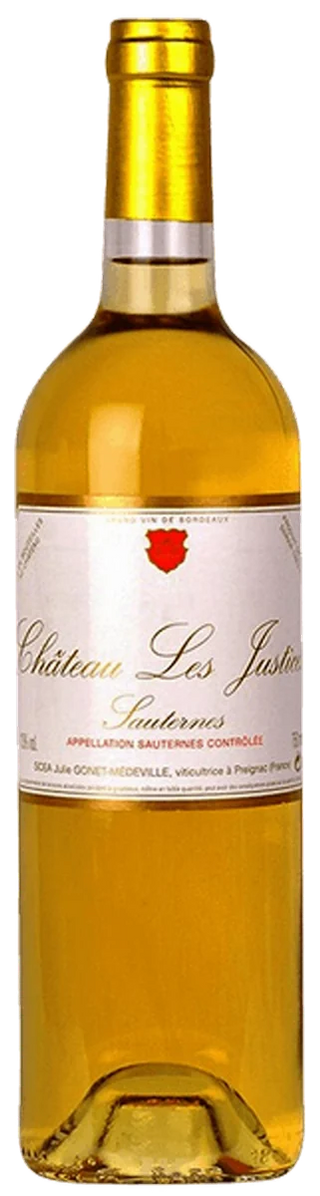
Château Les Justices Sauternes Branco 2023 (0,375L)
Château Les Justices Sauternes Branco 2023 (0,375L) - 2023 is backordered and will ship as soon as it is back in stock.
Buy a case of 6 and save 10%
€22.32
per bottle
€148.80
€133.92
case of 6
Discount applied automatically in the cart. Cannot be combined with other codes.
- Free shippingfrom €150
- Secure paymentSSL · MB Way · card
- Returns14 days
- KlarnaPay in 3, interest-free

Château Les Justices Sauternes Branco 2023 (0,375L) - 2023 is backordered and will ship as soon as it is back in stock.
TECH SHEET
Tap any tile to learn more
- Vintage
- 2023
- Country
- FranceFrance
- Region
- Bordeaux
- Type
- White
- Producer
- Vignobles Gonet-Médeville
- Winemaker
- Olivier Dauga
- Alcohol
- 13.5% vol.
- Bottle
- 0,375 L


Vintage
2023
3 years
White wine: fermented without the skins, favouring freshness and aroma.
Region · France
Bordeaux
The banks of the Gironde, Garonne and Dordogne in south-west France. The classic Cabernet Sauvignon–Merlot blend, plus benchmark whites and sweet wines.
Type
White
White wine: fermented without the skins, favouring freshness and aroma.
Producer
Vignobles Gonet-Médeville
Bordeaux, France
- Region
- Bordeaux, France
- Winemaker
- Olivier Dauga
Grapes
Grapes in this wine
- Sémillon85%See wines with Sémillon
- Sauvignon Blanc15%
Aromatic, crisp white: citrus, passion fruit and cut grass.
See wines with Sauvignon Blanc
Alcohol
13.5% vol.
ABV shows the % of alcohol by volume.
Guide scale for wine — suggestion by style.
Bottle
0,375 L
≈ 3 125 ml glasses
Wine profile
Body
This wine: 4 out of 5 — closer to «full».
How heavy and full the wine feels in your mouth — from light like skimmed milk to rich like cream. It comes mainly from alcohol, extract and, in sweet wines, sugar.
Wine profile
Acidity
This wine: 5 out of 5 — closer to «crisp».
The freshness that makes your mouth water, like a squeeze of lemon. It gives a wine tension, length and ageing potential, and makes it great with food.
Wine profile
Alcohol
This wine: 4 out of 5 — closer to «high» (13.5% vol.).
Alcohol brings warmth and body. Still wines usually sit between about 11% and 15% ABV, while fortified wines such as Port sit around 19–20%.
Wine profile
Sweetness
This wine: 5 out of 5 — closer to «sweet».
The residual sugar you can taste. EU label guide for still wines: dry up to ~4 g/L, medium-dry up to ~12 g/L, medium-sweet up to ~45 g/L, sweet above that.
Wine profile
White · gold
Tap or hover a scale
Typical: average of 453 whites at Vinogrande
Critics & awards
- Praise from Bordeaux critics: often highlighted by leading publications and critics (such as the Decanter or Wine Spectator teams covering the En Primeur tastings) for its impressive value for money.
- Fine Dining Presence: one of the most sought-after Sauternes, listed at the best Michelin-starred restaurants in France .
Not sure? Ask our AI Sommelier NEW
Pairings, alternatives and advice in seconds
Description
Château Les Justices Sauternes Branco 2023 (0,375L) is a great French sweet wine. It combines honey with very lively freshness. It's made from Sémillon and Sauvignon Blanc, Château les Justices / Domaine des Justices.
Tasting Note
Château Les Justices Sauternes 2023 has a highly expressive sweet profile, where the richness and concentration typical of Sauternes find in freshness one of their main virtues.
In the glass it's a bright, luminous golden yellow, suggesting concentration and elegance from the start.
AromaOn the nose it's intense, complex and very enveloping, dominated by acacia honey, dried apricot and candied orange peel. Notes of ripe mango and pineapple also appear, with delicate floral nuances of white flowers adding freshness and definition.
PalateOn the palate it's dense, full-bodied and juicy, with generous sweetness and a rich, enveloping texture. Yet it's the lively, citrusy, very well-integrated acidity that gives the wine balance and energy, offsetting its concentration and preventing any sense of excess sweetness. The result is a Sauternes both opulent and fresh, with excellent balance between richness, tension and elegance.
FinishThe finish is long, persistent and refined, carrying the notes of ripe fruit, honey and citrus and leaving a sense of great freshness.
Food pairingFood Pairings
Its combination of sweetness, acidity and texture lets it partner both great classics of French cuisine and more contemporary dishes.
Blue cheeses
Roquefort, Gorgonzola or Stilton make one of the most classic contrasts with Sauternes. The salty, piquant intensity of the cheese finds a perfect counterpoint in the wine's sweetness and acidity.
Foie gras and pâtés
The unctuous texture of foie gras or duck liver pâté goes particularly well with the wine's density and richness, while its acidity refreshes the palate and balances the fat.
Sweet-and-sour and spiced cooking
Dishes with sweet-and-sour elements or delicate spices can make very interesting matches, such as duck tacos with plum sauce or white meats with a mild curry.
Nut tarts
Almond or walnut tarts are an excellent complement to the wine's notes of honey, ripe fruit and apricot.
Fruit and citrus desserts
Tarte Tatin, apricot crumble or a not-too-sweet lemon meringue tart let you explore the wine's acidity for a particularly balanced match.
Crème brûlée
The creamy texture, vanilla and burnt caramel of crème brûlée naturally harmonise with this Sauternes' aromatic richness and elegant sweetness.
Pairing note: with desserts, it's best to choose ones that aren't sweeter than the wine. That way you preserve the perception of its fruit, freshness and balance.
What to serve with this wine
Dishes calculated from this wine’s profile, grapes and region.