
Review & get 10% off
Review this product and we’ll give you 10% off your next purchase. Write a review →
We offer 10% off your next purchase for every honest review, positive or negative.
Thank you for your review!
Here is 10% off your next purchase:
One use per customer. Cannot be combined with other offers.
We offer 10% off your next purchase for every honest review, positive or negative.
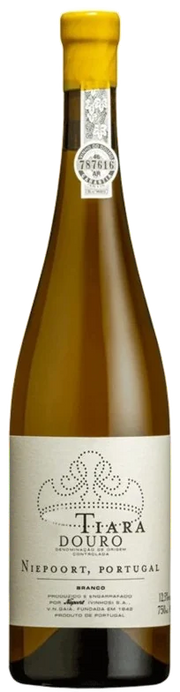
Niepoort Tiara branco 2024 — excecionalmente fresco, mineral e elegante
Niepoort Tiara branco 2024 — excecionalmente fresco, mineral e elegante - 2024 is backordered and will ship as soon as it is back in stock.
Buy a case of 6 and save 10%
€33.84
per bottle
€225.60
€203.04
case of 6
Discount applied automatically in the cart. Cannot be combined with other codes.
- Free shippingfrom €150
- Secure paymentSSL · MB Way · card
- Returns14 days
- KlarnaPay in 3, interest-free

Niepoort Tiara branco 2024 — excecionalmente fresco, mineral e elegante - 2024 is backordered and will ship as soon as it is back in stock.
TECH SHEET
Tap any tile to learn more
- Vintage
- 2024
- Country
- PortugalPortugal
- Region
- Douro
- Type
- White
- Producer
- Niepoort Vinhos
- Winemaker
- Dirk Niepoort
- Alcohol
- 11.5% vol.
- Bottle
- 750 ml

Vintage
2024
2 years
White wine: fermented without the skins, favouring freshness and aroma.
Region · Portugal
Douro
Terraced schist valleys along the Douro river, the world’s oldest demarcated wine region (1756). Hot, dry summers give concentrated reds, high-altitude whites and Port.
Type
White
White wine: fermented without the skins, favouring freshness and aroma.


Producer
Niepoort
Douro and Vila Nova de Gaia, Portugal · since 1842
A family Port house since 1842, now in its sixth generation. In 1987 it bought its first Douro estate, Quinta de Nápoles, and Dirk Niepoort began making table wines; Redoma 1991 was the first to be released. It combines tradition with a restless spirit of innovation.
- Founded
- 1842
- Region
- Douro and Vila Nova de Gaia, Portugal
- Winemaker
- Dirk Niepoort
- Signature wines
- Redoma
Winemaker
Dirk Niepoort
Winemaker
Born in 1964, he joined his father Rolf's Port house in 1987 and became the fifth generation to lead Niepoort. That year the family bought Quinta de Nápoles and Dirk began making Douro wines; Redoma 1991 was the first released. In 2023 he was inducted into the Decanter Hall of Fame.
- Producers & estates
- Niepoort
- Notable wines
- Redoma
Grapes
Grapes in this wine
- Blend led by Códega do LarinhoSee wines with Blend led by Códega do Larinho
- Rabigato
Upper Douro white with high acidity and minerality.
See wines with Rabigato - also including DonzelinhoSee wines with also including Donzelinho
- CercialSee wines with Cercial
- other grapes interplanted in the vineyardSee wines with other grapes interplanted in the vineyard
Alcohol
11.5% vol.
ABV shows the % of alcohol by volume.
Guide scale for wine — suggestion by style.
Bottle
750 ml
≈ 6 125 ml glasses
Wine profile
Body
This wine: 3 out of 5 — right in the middle.
How heavy and full the wine feels in your mouth — from light like skimmed milk to rich like cream. It comes mainly from alcohol, extract and, in sweet wines, sugar.
Wine profile
Acidity
This wine: 4 out of 5 — closer to «crisp».
The freshness that makes your mouth water, like a squeeze of lemon. It gives a wine tension, length and ageing potential, and makes it great with food.
Wine profile
Alcohol
This wine: 2 out of 5 — closer to «low» (11.5% vol.).
Alcohol brings warmth and body. Still wines usually sit between about 11% and 15% ABV, while fortified wines such as Port sit around 19–20%.
Wine profile
Sweetness
This wine: 1 out of 5 — closer to «dry».
The residual sugar you can taste. EU label guide for still wines: dry up to ~4 g/L, medium-dry up to ~12 g/L, medium-sweet up to ~45 g/L, sweet above that.
Wine profile
White
Tap or hover a scale
Typical: average of 453 whites at Vinogrande
Critics & awards
- James Suckling
- Robert Parker
Not sure? Ask our AI Sommelier NEW
Pairings, alternatives and advice in seconds
Description
Niepoort Tiara Branco 2024 is an exceptionally fresh, mineral and elegant Douro white made by the renowned Niepoort. From old vines over 60 years old at about 600 metres, it stands out for its energy and liveliness, departing from the region's traditional heavier whites.
The Wine AdvocateRP 95Reviewed by: Luis Gutiérrez
The 2024 Tiara is possibly the only white that turned out even better than the 2023. It's the only white from granite soils at high altitude and, in a vintage when the wine again made me think of a Riesling — though of course it isn't one. It has only a slightly higher proportion of Verdelho than the other whites, but shows delicate aromas of white flowers, citrus and stone.
It fermented and aged in old German foudres, with full malolactic, showing the purity and elegance of the best vintages. It's a fine, subtle and very delicate wine. 13,200 bottles were produced. It was bottled in February 2026.
I tasted the wines with Luis Pedro Silva, the young Niepoort winemaker in charge of the Douro wines. Most wines are from 2024, a less hot year with lots of vegetation and high yields — there was enough rain and the plants behaved as if irrigated. However, the hot summer made the plants suffer because of the large leaf mass and high yields, struggling to ripen all the fruit and keep the leaves green.
It was a very rainy harvest, which made it long and apparently better, as alcohol didn't rise and the wines kept their freshness. This was initially good for the Douro wines but bad for Port. However, the rain reactivated the plants, which eventually ripened the grapes destined for Port too.
The 2024 still wines have low alcohol and seem to be gaining volume. The reds are very floral, perhaps not as vibrant as the 2023s, while the whites are similar to the 2023s, perhaps a little rounder. Half the reds are 2023, a cooler vintage than 2022 and similar to 2021. Both 2023 and 2024 are very approachable, easy-to-enjoy vintages.
In 2025 it rained a lot throughout the year, making vineyard conditions challenging. Yields were low and the grapes were highly concentrated. After harvest it rained incessantly, really more than needed...
I tasted the Ports with Nick Delaforce, winemaker at Vale do Mendiz, where the Ports are made. Different vintages in various categories are being released, but the highlight was the new Vintage, the 2024. It's the next general declaration after 2022, as most producers didn't bottle a 2023 Vintage.
The portfolio make-up is the opposite of most big producers: at Niepoort about 60% is special categories and 40% entry-level, when it's usually the other way round. The rest of the 1976 Colheita was also bottled, a truly magical wine...
Published: 16 April 2026
What to serve with this wine
Dishes calculated from this wine’s profile, grapes and region.