Every year, on the third Thursday of November, France opens one of the most eagerly awaited bottles of the calendar: Beaujolais Nouveau. In 2026 the day is Thursday 19 November, and the first bottles can be served from midnight.
But Beaujolais is much more than the new wine. In this guide we explain what Beaujolais Nouveau is and why it has a fixed date, and introduce Beaujolais-Villages and the Beaujolais crus, the wines that show the Gamay grape at its best.
The new wine
What is Beaujolais Nouveau?
Beaujolais Nouveau is a primeur red wine made from Gamay in the Beaujolais region, south of Burgundy. It is bottled a few weeks after the harvest and meant to be drunk young: fresh, fruity, light and without much structure.
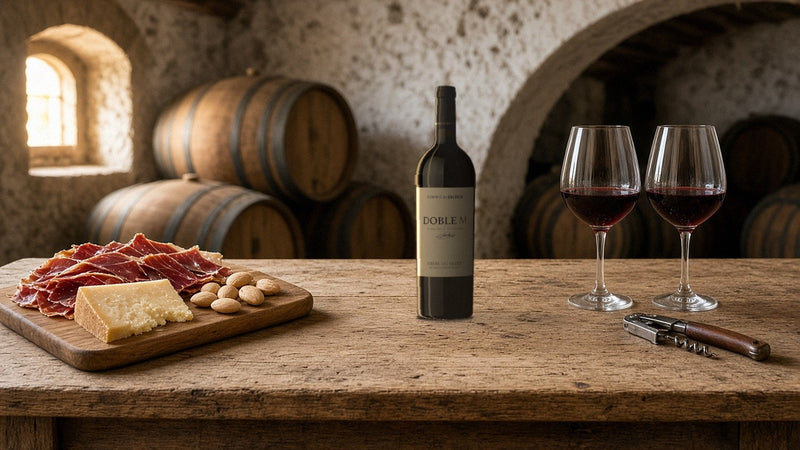
It is a wine for parties and good company rather than for ageing. In France it is celebrated in bistros with charcuterie and cheese, and the celebration has spread to many countries.
“A wine for parties and good company rather than for ageing.”
The date
Beaujolais Nouveau 2026: why 19 November?
Beaujolais Nouveau cannot be sold before the official date. Until 1967 the date was 15 November; since 1985 it has been fixed on the third Thursday of November. In 2026, according to the official notice from the Beaujolais interprofessional body, it goes on sale on Thursday 19 November at 00:00.
The fixed date turned the release into an event: the same wine reaches bars, wine shops and tables in many countries at the same time.
To celebrate at home you do not need much: a board of charcuterie and cheese, slow-fermented bread, a few friends and two or three different Beaujolais to compare. Opening a Nouveau alongside a Beaujolais-Villages and a cru is the quickest way to see how the same grape changes from place to place.
The region
Beyond Nouveau: Beaujolais-Villages and the Beaujolais crus
Beaujolais has a simple hierarchy. At the base is Beaujolais; above it, Beaujolais-Villages, from selected villages; and at the top the ten Beaujolais crus, each with its own name: Brouilly, Côte de Brouilly, Chénas, Chiroubles, Fleurie, Juliénas, Morgon, Moulin-à-Vent, Régnié and Saint-Amour.
The crus show that Gamay can make serious wines, with structure and the ability to develop in bottle. Morgon and Moulin-à-Vent are usually the fullest-bodied.
“The crus show that Gamay can make serious wines.”
The grape
Gamay: the grape of Beaujolais
Practically all red Beaujolais is made from Gamay, a thin-skinned grape that gives wines of vivid colour, aromas of cherry, raspberry and flowers, and light tannins. It is a generous, early-ripening grape that does especially well on the granite soils in the north of the region, where the crus lie.
For Beaujolais Nouveau, many producers use carbonic maceration: whole bunches ferment in a carbon-dioxide-rich environment, which lifts the fruit and aromas and gives soft wines ready to drink within weeks. For the crus, vinification is usually longer, to extract more structure.
At the Portuguese table
Beaujolais with Portuguese food
The freshness and light tannins of Gamay make Beaujolais a very versatile red at the Portuguese table. Try it with cured sausages and presunto, a cheese board, roast chicken or lighter salt-cod dishes. A cru such as Morgon or Moulin-à-Vent can handle more flavoursome dishes, such as roast kid or duck rice.
As it is served a little cooler than most reds, it is also a good choice for those who usually prefer whites.
Our selection
Where to buy Beaujolais in Portugal
Vinogrande does not sell Beaujolais Nouveau, but we have a small selection of Beaujolais-Villages, crus and Gamay from leading producers, perfect for celebrating 19 November with a wine of more depth:

L'Arlésienne Beaujolais-Villages "Aux Gauthiers" 2022
100% Gamay from old vines at 520 m; cherry, raspberry and violet.
View bottle
L'Arlésienne Morgon Corcelette Truges 2022
Morgon cru from old high-altitude vines; medium body, polished tannins.
View bottle
Thibault Liger-Belair Moulin-à-Vent Vieilles Vignes 2022
Moulin-à-Vent cru from vines over a hundred years old.
View bottle
Thibault Liger-Belair Bourgogne Gamay "Les 2 Terres" 2022
Grapes from Beaujolais and Burgundy; red and black fruit, spice.
View bottleExplore our full selection of French Wines.
Serving
How to serve Beaujolais
- Temperature: Gamay likes to be cool. Serve Nouveau and Beaujolais-Villages lightly chilled; the crus slightly less cold.
- Glass: a wide-bowled red wine glass helps the fruit open up.
- At the table: charcuterie, pâtés, soft cheeses, roast poultry and bistro dishes.
- Ageing: Nouveau is drunk in the following months; the crus can be kept for a few years.
FAQ
Frequently asked questions about Beaujolais Nouveau
When is Beaujolais Nouveau 2026 released?
On Thursday 19 November 2026, from 00:00, as every year on the third Thursday of November.
Which grape is used in Beaujolais?
Red Beaujolais is made from Gamay, a grape with vivid red fruit and light tannins.
Should Beaujolais Nouveau be aged?
No. It is a primeur wine, meant to be drunk young, in the months after release.
What is the difference between Beaujolais Nouveau and Beaujolais-Villages?
Nouveau is a wine of the year, released weeks after the harvest. Beaujolais-Villages comes from selected villages in the region and is usually more concentrated.
What are the Beaujolais crus?
There are ten: Brouilly, Côte de Brouilly, Chénas, Chiroubles, Fleurie, Juliénas, Morgon, Moulin-à-Vent, Régnié and Saint-Amour.
Is Beaujolais part of Burgundy?
Beaujolais lies immediately south of Burgundy and is often associated with it, but it is a region with its own identity and Gamay as its main grape.
To finish
A toast to 19 November
Whether with a freshly arrived Nouveau or a Morgon or Moulin-à-Vent cru, the third Thursday of November is the perfect excuse to discover Gamay. See the full selection in French Wines.
For the festive season, pair this discovery with ideas from our wine gifts selection.
Be responsible. Drink in moderation.